Case Study: AI Lead Routing for an SMB Services Team
Articles
BLOG DETAILS04 MAR 20266 min read
Discover how an SMB services team used AI lead routing to qualify inbound leads faster, assign them smarter, and reduce missed follow-up.
Inbound leads were coming in from multiple channels, but follow-up was too often dependent on chance. An email inquiry might get a quick response, while a lead from a form or chat could sit untouched for too long. That did not just slow the process down. It cost revenue.
In this case study, we show how an SMB services team used AI lead routing and smart sales automation to bring structure to lead follow-up, qualification, and handoff. The result was not only a faster first response, but a far more consistent process with fewer missed opportunities.
The challenge: leads were coming in, but not always reaching the right person
The issue was not lead volume. There were enough inbound opportunities. The bottleneck was in how they were handled.
The team worked across several channels at once:
#case study#AI lead routing#sales automation#CRM#lead follow-up#SMB#automation
edge cases needed human judgment, but there was no strong process for that
In practice, this led to inconsistent follow-up. And that is exactly where many SMBs lose conversion unnecessarily.
Why this is a business problem, not just an operational one
Many teams treat lead routing as an administrative step. That is a mistake.
When a lead is not followed up quickly and correctly, it affects multiple parts of the business:
1. Lower conversion
A strong lead that receives a late reply is often already talking to a competitor.
2. Higher acquisition costs
You invest in marketing, ads, or outbound activity, but lose return in the handoff to sales or service.
3. Poorer customer experience
For the prospect, slow or chaotic follow-up signals that the business is not organized internally.
4. Weak reporting and visibility
Without centralized intake and clear routing, you cannot see where leads are getting stuck.
That makes lead routing automation more than an efficiency project. It is a growth project. For a deeper look at building a leak-proof pipeline, read our guide on CRM automation and lead flow.
The approach: from fragmented intake to smart AI lead routing
To make the process scalable, we redesigned the full path from lead entry to handoff. The goal was not to automate everything blindly, but to standardize repetitive decisions and send exceptions to the right people.
The solution was built around four core elements.
1. Centralized lead intake with source recognition and tagging
The first step was simple but critical: all inbound leads had to enter through one central layer.
Instead of having separate intake paths per channel, we created a centralized intake flow where every lead was enriched with context right away, including:
lead source
inbound channel
request type
timestamp
campaign or landing page origin
contact details and available company information
This immediately created more visibility inside the CRM. The team no longer had to figure out where a lead came from or what context was missing.
The direct gains were clear:
less manual investigation
better data quality
more consistent CRM usage
better insight into channel performance
2. Qualification based on urgency and fit
Not every lead deserves the same priority. Still, the team had largely been handling inquiries in order of arrival or based on instinct.
To solve that, we added a qualification layer that automatically evaluated leads using predefined signals such as:
level of urgency
type of service
geographic match
business fit
complexity of the request
incomplete or unusual information
This is where AI lead routing delivered real value: not just assigning leads faster, but judging them more intelligently first.
An urgent request with a strong fit should not sit in the same queue as a general inquiry with no clear buying intent. By adding rules and AI logic to that decision, the follow-up became much smarter.
3. Automatic routing to the right owner
After qualification, each lead was automatically assigned to the right person or team.
The routing logic considered factors such as:
area of expertise
region
capacity
existing account ownership
request type
This created two major improvements.
First, ownership became immediately clear. There was no longer any confusion about who should handle a lead.
Second, response speed improved without adding another management layer. The system made the first routing decision automatically, which reduced delays between intake and follow-up.
For teams that want to scale, this is essential. As soon as lead volume rises, manual distribution almost always breaks down.
4. Human handoff for exceptions and edge cases
Full automation sounds appealing, but in most cases it is unrealistic. More importantly, it is often a bad idea.
Some leads require nuance. Think about:
complex requests
unclear intake
unusual combinations of services
strategically important accounts
leads with conflicting signals
That is why we deliberately built in a human handoff step. When the AI or rules engine did not have enough confidence, the lead was not forced through the system. Instead, it was flagged for quick human review.
That prevented avoidable mistakes at the front end and kept trust in the process high.
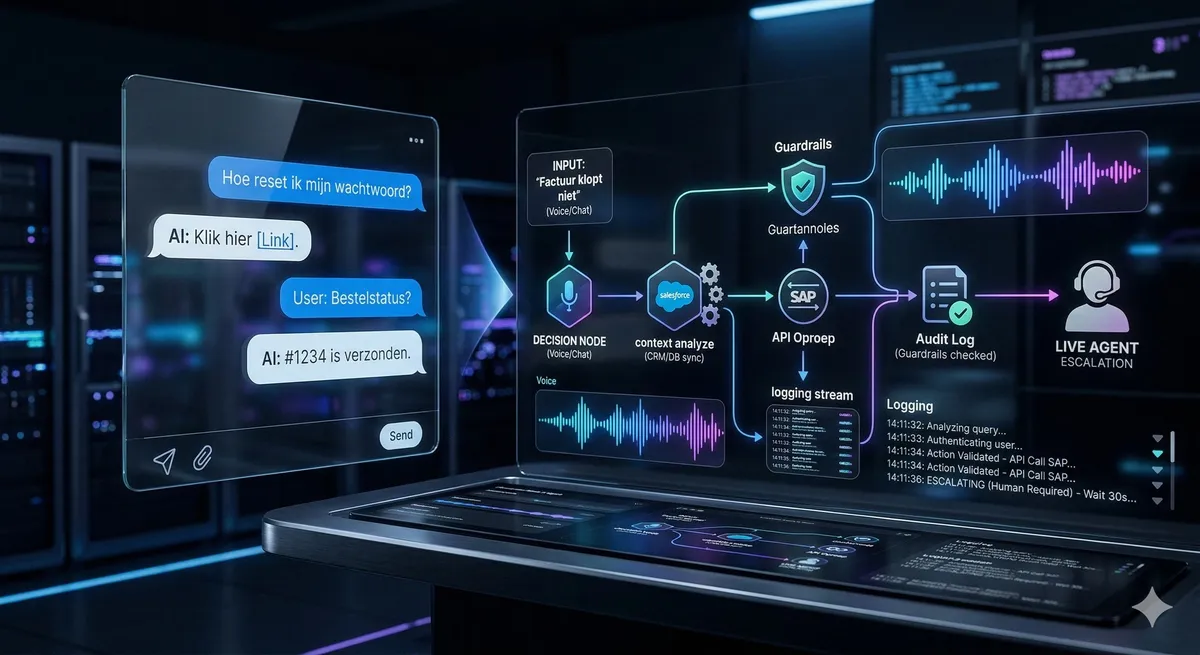
A lead enters through a form, email, chat, or manual input.
The system automatically adds source data and context.
The lead is qualified based on urgency, fit, and request type.
The system routes the lead to the right owner.
If there is uncertainty or an exception, the lead is sent to a human review step.
All statuses remain visible in the CRM and flow into weekly reporting.
That created a process that was both faster and easier to manage.
Results: fewer missed leads, more consistency
The outcomes were clear:
faster first response to new inquiries
fewer leads left untouched or lost between teams
clear ownership at every stage
better weekly visibility into pipeline and follow-up
less operational noise inside the sales process
But the biggest win was not speed alone.
The real improvement was consistency.
Before implementation, follow-up too often depended on who was available, which channel a lead came through, or how complete the intake was. After implementation, lead handling became a manageable system instead of a loose collection of manual actions.
That is what makes the process scalable.
Why this case is relevant for other SMBs
Many SMBs recognize this pattern:
marketing generates leads
sales wants faster follow-up
operations wants visibility
management wants reliable numbers
nobody fully owns the handoff in between
This is exactly where AI lead routing creates real advantage.
You do not need to be an enterprise business to benefit from it. In smaller teams, the impact is often even greater, because one missed lead or delayed response has a bigger effect on revenue and planning.
For SMBs, this typically creates direct value in five areas:
Efficiency
Less manual sorting, forwarding, and chasing.
Scalability
More leads can be handled without adding coordination linearly.
Cost savings
Less wasted marketing spend because follow-up improves.
Customer experience
Prospects get faster and more relevant contact.
Competitive advantage
The business that responds faster and more consistently usually wins more deals.
The key lesson from this case
The biggest mistake companies make is thinking lead routing is mainly about speed.
Speed matters, but without logic and ownership, it does not solve much. It just moves chaos through the system faster.
The real power of AI and automation comes from combining three things:
centralized intake
intelligent qualification
controlled handoff between system and human
Only then do you get a process that is reliable enough to scale.
Conclusion
This case study shows that AI lead routing for SMBs is not hype or a luxury. It is a practical way to gain control over lead follow-up, team capacity, and conversion.
By automating intake, qualification, and assignment in a smart way, this services team was able to respond faster, lose fewer leads, and operate with more predictability.
That is what strong automation should do in practice: not just save time, but make commercial processes stronger.
Want to explore how AI lead routing or sales automation could work in your business? Start with the Free AI Audit to map your current intake, qualification, and handoff process clearly. You can also browse our case studies for more real-world examples.